

Beyond Electronic Signatures: Why Faster Laboratory Approvals Require More Than a Digital Signature
Electronic signatures alone don't speed up lab approvals. Webinar insights on how connected LIMS workflows accelerate review and approval.
5 min read
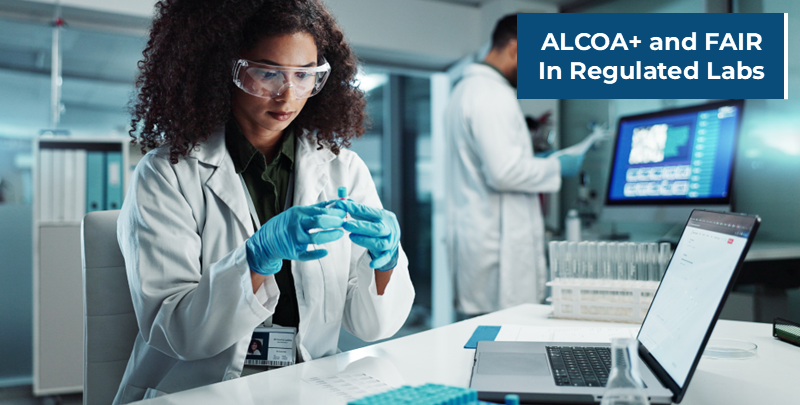
Most regulated laboratories have become very good at answering one question: can we trust this data? Audit trails, electronic signatures, access controls, and review workflows all exist to give the same answer: yes.
A second question is becoming just as important: can we actually use this data?
Can a scientist find a result from three years ago without relying on tribal knowledge? Can data move from a LIMS into analytics platforms, quality systems, partner organizations or AI tools without losing its meaning? Can an organization reuse what it already knows instead of paying to rediscover it?
ALCOA+ answers the trust question. FAIR answers the value question. Regulated laboratories increasingly need both.
ALCOA+ is the foundation of data integrity. It asks whether data is Attributable, Legible, Contemporaneous, Original and Accurate, plus Complete, Consistent, Enduring and Available. It underpins expectations such as 21 CFR Part 11 and the records requirements of ISO/IEC 17025. Its purpose is to prove that a record is authentic, trustworthy and defensible.
FAIR asks a different question. Is data Findable, Accessible, Interoperable and Reusable, not just by people but by systems?
ALCOA+ determines whether data can withstand regulatory scrutiny. FAIR determines whether data can create value after collection.
One protects compliance; the other protects return on investment.
FAIR is not a regulation, and no auditor will cite you for ignoring it. Labs that neglect it still pay, often for years: duplicated work, inconsistent reporting, slow investigations, stalled analytics projects, and AI initiatives that never get past data preparation.
The two frameworks complement each other, but they are not interchangeable.
| ALCOA+ asks… | FAIR asks… | |
|---|---|---|
| Identity | Who created or changed this record, and when? | Does this record have a unique, persistent identifier and rich metadata? |
| Availability | Can authorized people retrieve the record for its full retention period? | Can people and systems retrieve it through standard, well-defined access methods? |
| Consistency | Is the record complete and internally consistent? | Is it described with shared vocabularies so it means the same thing everywhere? |
| Longevity | Is the record durable and preserved in its original form? | Is it documented well enough that someone unfamiliar with it could reuse it correctly? |
A laboratory can fully satisfy ALCOA+ and still fail FAIR. Imagine a result with a complete audit trail, electronic signatures, and proper access controls. It is unquestionably trustworthy. It is also stored under a site-specific test code, with inconsistent units and no clear link to the method version that produced it.
The data is compliant. It is also nearly impossible to find, compare, or reuse at scale.
The opposite problem exists too. A well-organized repository of searchable datasets may look FAIR on the surface. But if no one can show who modified the data, when or why, it fails the basic test of a regulated environment.
Trust without usability wastes potential. Usability without trust creates compliance risk.
One of the most persistent misunderstandings about FAIR is that it requires making data public. It does not.
Under FAIR, accessibility means data can be retrieved through well-defined, standardized mechanisms, and those mechanisms can and often should include authentication, authorization, and role-based security. Patient results, batch records and proprietary formulations can all be FAIR while remaining tightly controlled.
FAIR isn't about removing doors. It's about making sure everyone knows where the doors are, how they work, and who is allowed through them.
Viewed that way, FAIR fits naturally with the access controls that Part 11 and ISO/IEC 17025 already demand.
FAIR isn't implemented through policy. It's implemented through operational decisions in the systems that create and manage data.
Findable: govern master data. Most FAIR problems begin with inconsistent master data. When products, tests, analytes, specifications, methods, and units are defined once and governed centrally, every result inherits searchable, reliable metadata. When they aren't, organizations spend years reconciling different names for the same thing.
That's why strategic master data management is a FAIR initiative, even if nobody calls it one.
Accessible: standardize how data is retrieved. Data should move through governed interfaces and controlled workflows with role-based security. If critical lab information still travels through emailed spreadsheets and manual exports, both accessibility and integrity are at risk.
Interoperable: connect systems without losing context. Instruments feed the LIMS, and the LIMS exchanges data with MES, QMS, ERP, and analytics platforms. Every transfer is a chance for context to disappear, so the goal isn't just moving data but preserving its meaning.
Direct integrations do that. Recent examples include our work with METTLER TOLEDO LabX, Körber's MES and Phizzle's cleanroom instrument platform. Read more in How LabWare Integrations Connect Your Quality Lab Systems and Instruments.
Reusable: preserve provenance. A result becomes reusable when its context stays intact: which method generated it, which instrument was used, which reagent lot was involved, and which specification it was judged against.
A unified LIMS and ELN platform that links samples, methods, materials, and results keeps that provenance attached. Without it, a result may be valid but not reusable. In regulated work, reuse has to be defensible.
Notice how much of this is already data integrity work. Audit trails provide provenance. Controlled master data provides consistency. Secure interfaces provide governed access.
For most regulated labs, FAIR isn't a new project. It's a way to get more value from the integrity foundation they've already built.
For years, FAIR was treated as worthwhile but optional. Two trends are changing that.
The first is AI.
Organizations want predictive quality, anomaly detection, intelligent search, and machine-learning insights. But the most common obstacle in lab AI projects isn't the model. It's data that is fragmented, inconsistent, and poorly described.
As we explored in Why Robust, Structured Data Is the Cornerstone of AI in LIMS, FAIR principles provide a practical blueprint for making data usable by machines and people. Our five practical steps to structure and enrich LIMS data put that blueprint into practice.
The second is the connected laboratory.
Labs now operate across more systems, sites, partners, and platforms than ever. Every boundary data crosses is a chance to lose context.
Interoperability is no longer a technical convenience.
It's the difference between generating insight and spreading confusion faster.
You don't need a formal FAIR program to find opportunities for improvement. Start with these:
If those questions are hard to answer, FAIR deserves your attention.
For decades, laboratories have been judged on whether their data could be trusted.
Increasingly, they'll be judged on whether it can be used: to compare sites, support investigations, accelerate technology transfer, power analytics and AI, and draw value from years of accumulated knowledge.
ALCOA+ answers the trust question. FAIR answers the value question.
The laboratories that succeed over the next decade won't choose one over the other. They'll build data that's trustworthy and reusable, compliant and interoperable, audit-ready and AI-ready.
See how LabWare helps regulated labs build data that is trusted, reusable, and ready for AI. Contact our team to learn how unified master data, connected systems, and integrated laboratory workflows support both ALCOA+ data integrity and FAIR data principles.
Electronic signatures alone don't speed up lab approvals. Webinar insights on how connected LIMS workflows accelerate review and approval.
Legacy LIMS may look stable but hide errors, delays and hidden costs. Learn five signs it is holding your lab back and how to start fixing them.
How LabWare's Enterprise Laboratory Platform turns connected, structured data into the foundation for precision, compliance, and confident decisions.